



 October 1, 2026
297
October 1, 2026
297
What business pours 95 cents of every dollar back into Canada; is a huge economic boon to our Huron-Bruce region; has the goal to achieve zero greenhouse gas emissions by 2027; and will help contribute to a “net-zero” Canada by 2050, while also growing the economy?
And don’t forget, it has a sideline business of helping to save lives when it comes to fighting cancer.
You guessed it - that would be Bruce Power.
After many years of talking about it, I finally took the free bus tour offered by Bruce Power. Like the 20,000 other people who visit the site, annually, I wanted to know more and to understand this business partner located near where I live.
The tour was memorable, well-organized and, yes, full of facts and statistics. In short, Bruce Power offers a great education focused on how nuclear power plants work, as well as the history of the Bruce Nuclear site, and how it is building for the future.
There’s a lot of information offered at the visitor information centre/museum, and during the bus tour, you learn more about the plant. For me, it was a very cool learning experience. I think Bruce Power is best explained by the fact that it has many systems working together.
Nuclear power is considered clean electricity which also means cleaner air, a reduction in carbon dioxide, and basically, lowering emissions and waste.
The primary objective of a CANDU (Canada Deuterium Uranium) reactor is to generate heat which is used to produce steam. The steam drives the turbine, producing electricity.
The first reactor was built at Douglas Point and ran from 1967-84 That reactor is now shut down. It was followed by the building of Bruce A and then Bruce B. There are currently eight CANDU reactors producing 30 per cent of Ontario’s power, and are expected to supply power through to the year 2064.
Each one of Bruce Power’s reactors is capable of generating enough low-cost, reliable, safe and carbon-free electricity to meet the annual needs of a city the size of Ottawa.
A proposed Bruce "C" plant is currently undergoing assessment. Bruce Power has initiated a federal Impact Assessment for the project which aims to create an option to build up to 4,800 megawatts (MW) of nuclear capacity at the site.
For more than 35 years, the Bruce Nuclear site has been producing medical isotopes and is a world leader using an isotope (Cobalt-60) to sterilize medical devices and apply it to cancer treatment and radiation therapy. More recently, in 2022 Bruce Power created the world’s first Isotope Production System (IPS) working with Kinectrics and Framatome and the Saugeen Ojibway Nation. The goal is to produce more of these systems to support cancer patients around the world.
Bruce Power is a Canadian-owned partnership among TC Energy, Ontario Municipal Employees Retirement Systems (OMERS), the Power Workers’ Union and the Society of United Professionals.
There are 4,200 employees who work at the world’s largest nuclear power plant. It’s a great opportunity for anyone working in the skilled trades and for those supporting them. This is never more true with the anticipation of the new Bruce "C" project. The plant offers jobs to journey persons and apprentices on site, and construction workers carry the highest demand at Bruce Power.
Security and safety are Bruce Power's number one priority. I learned that 20 per cent of an employee’s workload is focused on safety training. Environmental safety and responsibility are also included into all aspects of the company’s nuclear safety culture.
Another neat factoid is that the huge red crane that sits on the Bruce Power site is the world’s largest crane and was recently used to help build the Gordie Howe Bridge. Things you never thought you’d learn on a Bruce Power bus tour!
Bruce Power also invests about $4-billion, annually, into Ontario. Together with the Darlington and Pickering nuclear plants, Bruce Power provide 60 per cent of Ontario’s power.
The Bruce Nuclear site is located on the eastern shore of Lake Huron near Tiverton (Municipality of Kincardine), within the traditional lands and treaty territory of the people of the Saugeen Ojibway Nation, which includes the Chippewas of Nawash Unceded First Nation and the Chippewas of Saugeen First Nation. Bruce Power is committed to honouring Indigenous history and culture, and to moving forward in the spirit of reconciliation and respect with the Saugeen Ojibway Nation, Georgian Bay Métis Nation of Ontario and the Historic Saugeen Métis, and to leading by example in this community and industry.
The visitors’ centre offers interactive educational presentations for students from Kindergarten to Grade 12, as well as post-secondary school and the trades.
I know I have missed a lot of other information about Bruce Power so you can check out the tour yourself. The bus tours end next week, Oct. 8. You can contact the visitors’ centre at BNPDVisitorCentre@brucepower.com or call 519-361-7777 for information or to book a visit or sign up through the site on Facebook.
So, no matter what age you are, be sure to add the tour to your to-do list!
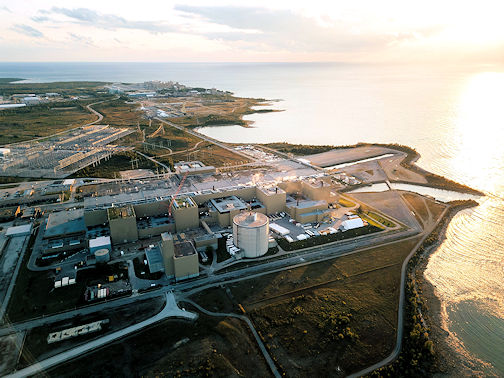
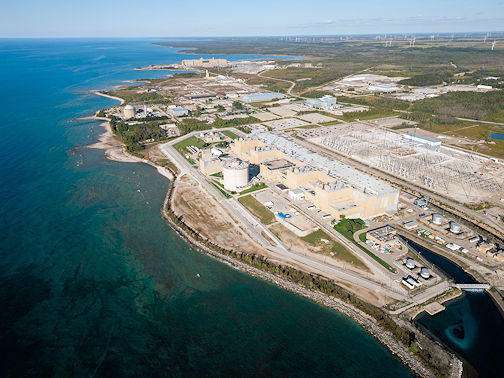
The Bruce Power nuclear generating site, near Tiverton, in the Municipality of Kincardine - Bruce A (above) and Bruce B (below); photos courtesy of Bruce Power
Written ByKim Dixon started her career in journalism in Manitoba, and was a writer for both non-profit and corporate clients. She writes short stories and is active with the area’s Writers' BLOC. She is also a volunteer VON fitness instructor in Kincardine. Jan. 1, 2025, she took her first polar plunge into Lake Huron.
Related Stories
No related stories.