



 September 30, 2026
66
September 30, 2026
66
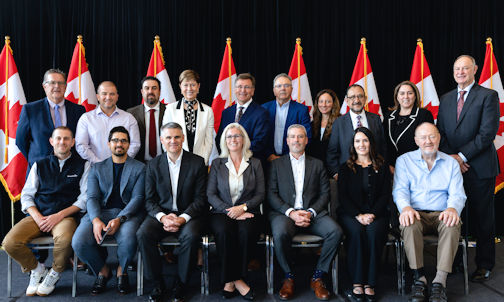
The Nuclear Innovation Institute (NII), which is based in Port Elgin and Tiverton, has launched the Canadian Centre for Space Isotopes — the leading voice for advancing Canada’s space isotope sector — in Toronto.
Building on the country’s long-standing leadership in medical isotope production, the centre will extend that same expertise into the space sector, driving research, policy and industry collaboration through 2030 — aligned with Canada’s commitment to double its isotope production.
Canada’s role in space innovation and exploration is growing. According to the Canadian Space Agency, the industry contributed $3.8-billion to federal Gross Domestic Product (GDP) in 2024 — up 14 percent since 2019 — supporting more than 28,000 direct and indirect jobs across Canada.
In his keynote address to kick off the event, Colonel Chris Hadfield asserted the need for Canada’s continued leadership in space exploration, drawing on his experience as the first Canadian commander of the International Space Station. “The exploration and utilization of space are rapidly growing, and reliable, long-term power sources are key for many missions. I am excited and proud that Canada is using our raw materials and skilled engineering know-how to lead the world.”
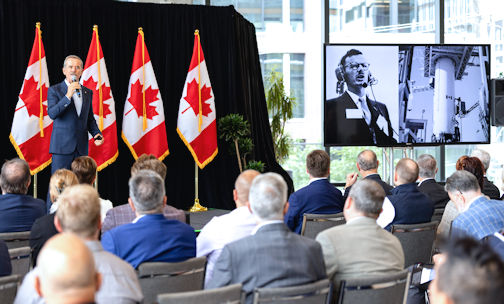
Colonel Chris Hadfield (left) delivers the keynote address at the launch of the Canadian Centre for Space Isotopes, Tuesday, in Toronto
“From the Canadarm to Jeremy Hansen’s historic lunar fly-by aboard Artemis II, Canada has always punched above its weight in space," said James Scongack, NII board chairman and Canadian Centre for Space Isotopes steering committee co-chairman. "That same ingenuity has also made us a world leader in medical isotope production. The Canadian Centre for Space Isotopes exists to find out what becomes possible when those two strengths meet.”
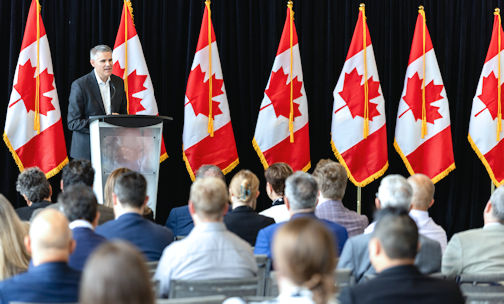
Announcing the new Canadian Centre for Space Isotopes, NII board chairman James Scongack (left) speaks on Canada’s leadership in space exploration and expertise in medical isotopes
“Space isotopes are essential to advancing scientific discovery and enabling the next generation of space missions," said John D'Angelo, president of Kinectrics and steering committee co-chairman. "The Canadian Centre for Space Isotopes reflects a shared commitment to strengthening Canada’s leadership through expertise, innovation, and partnerships that will usher in a new era of space exploration.”
“Thanks to the Canadian Centre for Space Isotopes, what was once science fiction will move ever faster into our everyday reality," said John MacQuarrie, president of commercial operations at BWXT and steering committee co-chairman. "Developing these special isotopes will help us to explore deeper into space and even help to make the moon or Mars habitable to benefit humanity.”
Radioisotope power systems play a critical role in space exploration. These systems generate electricity by converting the heat released from the natural decay of isotopes into a reliable source of power for probes, rovers and more. As global demand for these systems grows alongside the pace of space exploration, Canada is well-positioned to carve out this niche where it can become a leader, as well as a trusted partner on the world stage.
 “By convening specialists from the nuclear sector, the space industry and the broader research community, the centre will advance policy-focused research and help cultivate the partnerships required to strengthen Canada’s role as a leader powering space exploration,” said Jessica Linthorne, NII president and chief executive officer (CEO), and centre steering committee co-chairperson (right).
With an upcoming report that will explore the opportunity to make a Canada a leader in space isotopes — to be released in early 2027 — the centre’s expert panel brings a wealth of leadership, experience and advocacy in the space and energy sectors. These members include:
Dr. Douglas Boreham, professor, Northern Ontario School of Medicine University
Pam Damoff, CEO, The Pearson Centre
Dr. Andrei Hanu, senior scientist – Dosimetry, Bruce Power
Dr. Justin Kasper, chief of technology, BWXT
Peter McDermid, director of business development, Bruce Power
Dr. Husain Mehdi, director of lifecycle management, Kinectrics
Bharath Nangia, president and CEO, Nuclear Promise X (NPX)
Darryl Spector, president, Promation
Dr. Paul Spekkens, executive consultant, Kinectrics
Bill Walker, vice-president of government and stakeholder relations, BWXT
John Yakabuski, former minister of natural resources and forestry and former MPP for Renfrew–Nipissing–Pembroke
Learn more about the mission at isotopesforspace.ca.
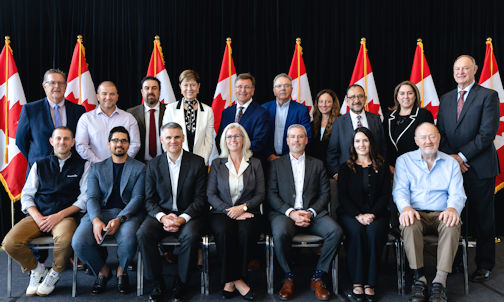
Members of the Canadian Centre for Space Isotopes expert panel, along with centre leads at the Nuclear Innovation Institute and members of the federal Liberal Nuclear Caucus gather for a photo at the launch
Related Stories
No related stories.